By Smart IAS Foundation | Published: April 23, 2025 |
Category: APSC Preparation |
Reading time: ~8 min
The honest answer is — YES. But only if you stop studying randomly and start studying strategically. Every year, serious aspirants clear APSC Prelims not because they spent years cramming, but because they followed a focused, revision-driven plan with the right guidance. This article gives you that exact plan.
Most APSC aspirants who fail at the Prelims stage have one thing in common — they work hard but without direction. They study for long hours, read multiple books, and yet fall short when it matters most. The reason is not a lack of effort. It is a lack of a structured, time-bound system designed specifically for APSC.
At Smart IAS Foundation, we have mentored hundreds of APSC aspirants and identified the exact strategy that converts limited time into maximum marks. In this article, we break down a complete 2-month APSC preparation plan — covering daily schedule, subject rotation, mock test strategy, Assam-specific preparation, and the most common mistakes you must avoid.
1. What You Should Focus on in These 2 Months
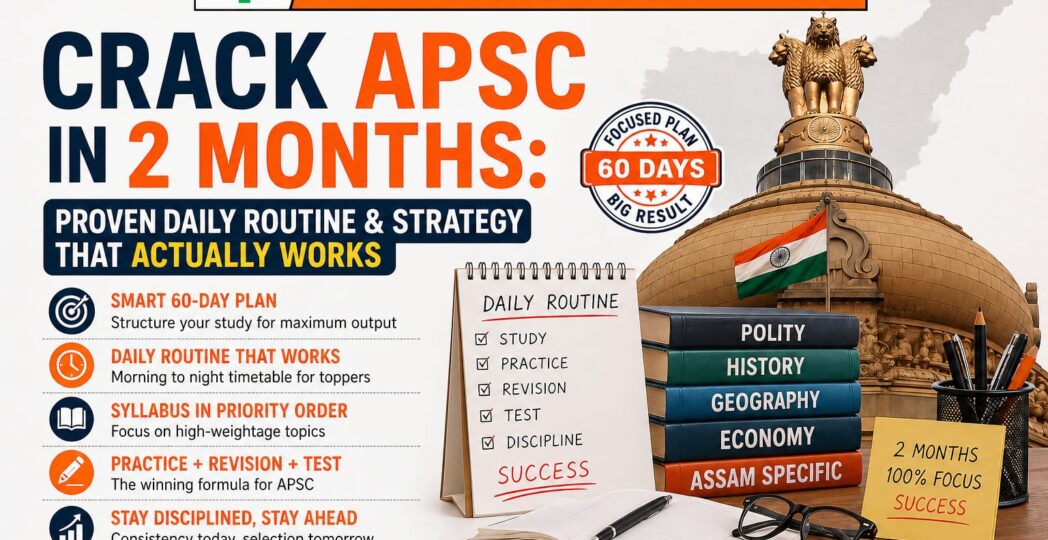
Two months is enough time to clear APSC Prelims — but only if you are absolutely ruthless about what you study and what you skip. This is not the time for new books or new topics. This is the time for consolidation, revision, and performance calibration.
Here is your non-negotiable focus list for the 2-month window:
- Conceptual Clarity over Rote Learning — Understand core concepts so you can tackle application-based MCQs.
- Smart Revision Strategy — Revise every topic at least 3 times in 2 months using spaced repetition.
- Daily MCQ Practice — Solve a minimum of 60–80 MCQs every day across subjects.
- Assam-Specific Preparation — APSC has a dedicated Assam GK component that can make or break your score.
- Mock Tests + Deep Analysis — One full-length mock every week with thorough post-test review.
- Consistent Routine — Consistency over intensity. A moderate routine followed daily beats a heroic routine followed occasionally.
2. APSC 2-Month Daily Routine (Hour-by-Hour Schedule)
This is the exact daily schedule used by high-performing APSC aspirants. It is designed to cover maximum ground, ensure regular revision, maintain physical health, and simulate exam-like conditions — all within a single day.
| Time Slot | Phase | Activity |
|---|---|---|
| 5:00 – 5:30 AM | Wellness | Meditation, light stretching, or pranayama — essential for focus and mental endurance |
| 5:30 – 6:30 AM | Morning Routine | Get ready, healthy breakfast — do not skip meals during intense preparation |
| 6:30 – 9:30 AM | Morning Study | Current Affairs (concept-based reading + revision notes) + 30 MCQs on current affairs |
| 10:00 AM – 1:00 PM | Mid-Morning Study | Subject study as per rotation plan (see Section 3) + 30–40 subject MCQs |
| 1:00 – 2:00 PM | Lunch + Rest | Healthy meal + 20-minute power nap — critical for afternoon retention |
| 2:00 – 4:00 PM | Afternoon Practice | CSAT practice (Paper II) + Previous Year Questions (PYQs) from last 10 years |
| 4:00 – 4:30 PM | Break | Short walk, tea break — physical movement resets focus |
| 4:30 – 7:30 PM | Evening Study | Second subject as per rotation plan (Polity / Environment / Assam GK / General Science) |
| 8:00 – 9:00 PM | Night Revision | Recall and revise everything studied that day — write key points without looking at notes |
| 9:00 – 9:30 PM | Wind Down | Skim next day’s topics, prepare notes/materials — sleep by 10:00 PM |
3. Subject Rotation Plan (Monday–Thursday)
A structured subject rotation plan ensures that no area is neglected and every topic gets periodic attention. The following plan is optimized for APSC Prelims coverage:
| Day | Mid-Morning (10 AM – 1 PM) | Evening (4:30 PM – 7:30 PM) |
|---|---|---|
| Monday | History (Ancient, Medieval, Modern India) | Polity & Governance (Constitution, Bodies, Acts) |
| Tuesday | Geography (Indian + World Physical Geography) | Environment & Ecology (Biodiversity, Climate, Schemes) |
| Wednesday | Economy (Basic Concepts, Budget, Schemes, Indices) | Assam-Specific Topics (History, Culture, Geography, Polity) |
| Thursday | Full-Length GS Paper I Mock Test | General Science + Mock Test Analysis (GS II) |
This 4-day rotation covers all core APSC subjects without creating topic fatigue. It also dedicates a full Thursday to mock tests — which is the most powerful single habit you can develop for competitive exam performance. Learn more about our APSC Mock Test Series at Smart IAS Foundation.
4. The 4-Day Cycle: The Real Game-Changer in APSC Prep
Most aspirants study in a weekly rhythm. We recommend a 4-day cycle instead — and here is why it dramatically outperforms a standard 7-day plan:
- Day 1–3 (Mon–Wed): Full syllabus coverage with MCQ integration and active recall
- Day 4 (Thu): Full-length mock test (GS Paper I + Paper II) followed by a detailed error analysis session
- Repeat: Start the next cycle on Friday — giving you more revision cycles per month than a weekly plan
In 2 months (approximately 60 days), a 4-day cycle gives you 15 full revision cycles compared to only 8 cycles in a weekly plan. That means every topic gets touched 15 times instead of 8 — nearly double the revision depth. This is why aspirants following this model at Smart IAS Foundation consistently outperform peers who study longer but less systematically.
5. Assam-Specific Preparation: The Difference Maker in APSC
Unlike UPSC, the APSC Combined Competitive Examination includes a significant portion of questions on Assam-specific topics. Many aspirants who perform well in standard GS topics still fall short because they underestimate — or completely neglect — this section.
Key Areas for Assam-Specific APSC Preparation:
- Assam History — Ahom Kingdom, Anglo-Assam Wars, freedom movement, post-independence developments
- Assam Geography — Brahmaputra river system, biosphere reserves, national parks, districts and their significance
- Culture & Heritage — Bihu, satras, tribes of Assam, languages, crafts, classical arts
- Assam Economy — Tea industry, oil and gas sector, agriculture, government schemes specific to Assam
- Assam Polity — Structure of APSC, state legislature, important constitutional provisions for Northeast India
- Current Affairs — Assam-specific news, government initiatives, recent developments in infrastructure and policy
At Smart IAS Foundation, our APSC 2-month crash course dedicates structured sessions every Wednesday evening specifically to Assam GK — ensuring aspirants are fully prepared for this high-scoring but often-ignored section.
6. Common Mistakes APSC Aspirants Must Avoid in 2-Month Preparation
The difference between aspirants who clear Prelims and those who don’t is often not the number of hours studied — it is the absence of these critical errors:
| ❌ Common Mistake | ✅ Smart Alternative | Why It Matters |
|---|---|---|
| Ignoring Assam-specific topics | Dedicate 3 hrs/week to Assam GK | Assam GK questions can swing your score by 10–15 marks |
| Not solving PYQs regularly | Solve PYQs daily in afternoon session | PYQs reveal exam patterns and frequently repeated topics |
| Skipping mock tests | One full mock every 4 days | Mocks build speed, accuracy, and mental stamina |
| Studying without revision | Revise before every new topic session | Without revision, 70% of information is lost within 24 hours |
| Reading new material in the last 2 weeks | Switch to 100% revision + MCQs | New learning in the last fortnight creates confusion, not clarity |
| Neglecting CSAT (Paper II) | 2 hrs of CSAT practice daily in afternoon | CSAT is qualifying but a poor score can eliminate you regardless of GS marks |
7. How Smart IAS Foundation Helps You Crack APSC Faster
Most APSC aspirants do not fail because they lack intelligence or dedication. They fail because they lack the right guidance system — a structured curriculum, expert mentorship, and performance feedback that keeps them on track throughout the preparation journey.
Here is what our APSC 2-Month Crash Course at Smart IAS Foundation offers:
- Structured 2-Month Crash Course Curriculum — Syllabus divided into focused daily sessions with no topic left behind
- Daily MCQ Practice & Discussion — 60–80 MCQs every day with detailed explanation sessions
- Full-Length Mock Tests with Analytics — Exam-level papers with subject-wise performance tracking and feedback
- Assam-Specific GK Focus — Dedicated sessions on Assam history, culture, geography, economy, and current affairs
- Personal Mentorship & Doubt Support — One-on-one guidance to resolve subject doubts and strategy questions
- Revision Schedules & Study Material — Curated notes, fact sheets, and revision planners designed for quick absorption
We don’t just teach content — we guide you through the entire preparation journey until you walk out of that exam hall with confidence. Explore our APSC Crash Course details and book your free demo today.
🚀 Limited Seats Available
Start Your APSC Final Push with Smart IAS Foundation
Join Assam’s most focused APSC coaching program. Get daily MCQs, mock tests, Assam GK sessions, and personal mentorship — all in one structured 2-month plan.
Frequently Asked Questions (FAQs)
Q1. Can I crack APSC Prelims in just 2 months?
Yes, cracking APSC Prelims in 2 months is achievable with a structured, revision-focused strategy. The key is to prioritize high-weightage topics, solve PYQs daily, and take regular full-length mock tests. Many aspirants clear Prelims through focused 2-month sprints under expert guidance at institutes like Smart IAS Foundation.
Q2. How many hours should I study daily during the 2-month APSC preparation?
Aim for 10–12 focused study hours daily. Distribute this across morning current affairs and MCQ sessions, mid-morning subject study, afternoon CSAT and PYQ practice, evening subject rotation, and night revision. Quality and consistency matter far more than total hours.
Q3. Which subjects are most important for APSC 2-month preparation?
Focus on Current Affairs, Indian History, Geography, Polity & Governance, Economy, Environment & Ecology, Assam-Specific GK, CSAT, and Previous Year Questions. Assam GK is particularly high-value in APSC and is often underestimated by aspirants coming from a UPSC background.
Q4. What is the APSC 4-day study cycle and why is it more effective?
The 4-day cycle covers the full syllabus with MCQ practice from Monday to Wednesday, then dedicates Thursday to a full-length mock test plus deep analysis. Repeating this in 60 days gives you 15 complete revision cycles — nearly double what a weekly plan provides — ensuring deeper retention and better exam readiness.
Q5. How important are mock tests in 2-month APSC preparation?
Mock tests are non-negotiable. Schedule at least one full-length GS I + GS II mock every week (or every 4 days as per the rotation plan). Post-test analysis — identifying weak areas, improving accuracy, and tracking speed — is what separates aspirants who improve from those who keep repeating the same mistakes.
Q6. What are the biggest mistakes in last-minute APSC preparation?
The most damaging mistakes include neglecting Assam-specific topics, not solving PYQs regularly, skipping mock tests, studying new material without revising previous content, and ignoring CSAT. These errors directly cost marks — and sometimes selection — in the Prelims stage.
Q7. Does Smart IAS Foundation offer a 2-month APSC crash course in Guwahati?
Yes. Smart IAS Foundation offers a comprehensive 2-month APSC Crash Course covering daily MCQ sessions, subject-wise classes, full-length mock tests with analytics, Assam GK focus, and one-on-one mentorship. You can attend a free demo class to evaluate the program before enrolling. Seats are limited — check availability at smartiasfoundation.com.
Conclusion: 2 Months, One Goal — Crack APSC
Cracking APSC in 2 months is not about studying harder. It is about studying smarter — with a clear plan, disciplined execution, and the right guidance by your side. The routine and strategy outlined in this article have been tested and refined through real APSC preparation cycles. They work — but only if you follow them consistently.
Every day you delay structured preparation is a day your competitors gain an edge. Start today. Follow the 4-day rotation cycle. Prioritize Assam GK. Solve PYQs every afternoon. Take your Thursday mock test seriously. Revise every night.
And if you want expert guidance every step of the way — a structured curriculum, daily MCQ practice, exam-level mock tests, and personal mentorship — Smart IAS Foundation is ready to support you all the way to selection.
👉 Attend a FREE Demo Class Today
👉 Download the Free APSC 2-Month Study Plan PDF
Disclaimer: The study schedule and preparation strategy shared in this article are based on general best practices for APSC exam preparation and the experience of Smart IAS Foundation faculty. Individual results may vary based on prior preparation level, subject background, and consistency of implementation. This content is intended for informational and guidance purposes only. Aspirants are advised to also refer to the official APSC notification and syllabus available on the Assam Public Service Commission’s official website before finalising their preparation plan.