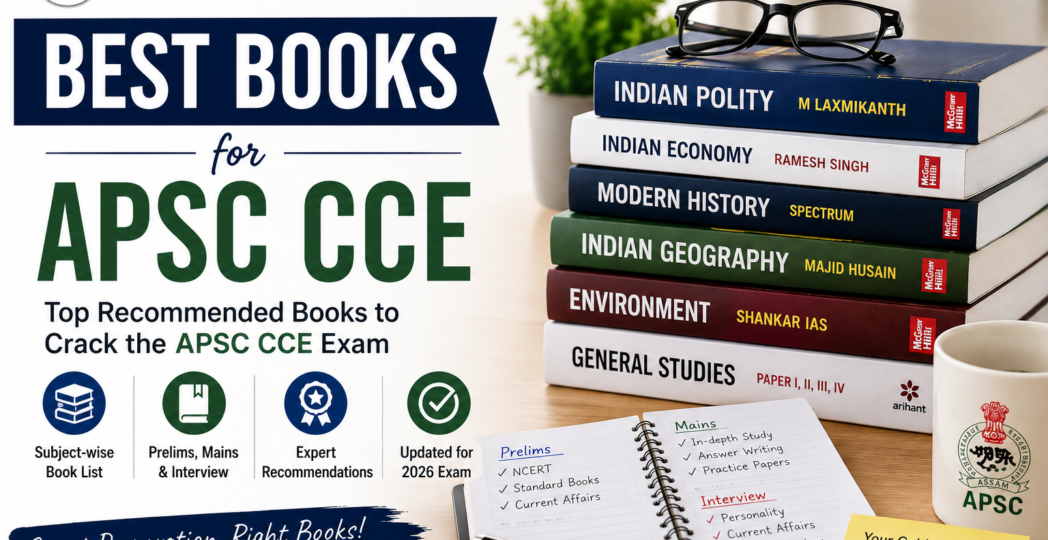
Choosing the best books for APSC CCE is one of the most consequential preparation decisions you will make — and one of the most commonly made wrong. Every year, Smart IAS Foundation’s faculty sees two opposite errors: aspirants who collect 8–10 books per subject and read none of them thoroughly, and aspirants who rely entirely on NCERTs and brief notes without building adequate analytical depth for Mains. Both extremes fail. The path to clearing the APSC CCE runs through the best books for APSC CCE — but through the right number of them, read in the right order, with the right level of depth.
This article gives you the complete best books for APSC CCE list — subject by subject, paper by paper, stage by stage. Every recommendation is backed by 15 years of APSC result analysis at Smart IAS Foundation, refined through the real performance data of hundreds of selected candidates who have cleared the Assam Civil Services since 2009. The list covers the best books for APSC CCE for every GS subject in Prelims and Mains, the most critical Assam GK resources for GS Paper V, the best books for APSC CCE CSAT Paper II, current affairs sources, and — equally important — which books to avoid.
Last Updated: April 28, 2026 | Aligned with APSC CCE 2025 Syllabus (Advt. No. 01/2026, April 10, 2026)
📥 Download Official Syllabus Before Reading This List
Every book recommendation here is mapped to the official APSC CCE syllabus. Download it first so you can cross-reference:
👉 APSC CCE Syllabus PDF – Download Here
📋 Table of Contents
- The Golden Rule of Book Selection for APSC CCE
- NCERT Books – The Non-Negotiable Foundation
- Best Books for APSC CCE – History
- Best Books for APSC CCE – Geography
- Best Books for APSC CCE – Indian Polity
- Best Books for APSC CCE – Economy
- Best Books for APSC CCE – Environment & Ecology
- Best Books for APSC CCE – General Science & Technology
- Best Books for APSC CCE – Ethics (GS Paper IV)
- Best Books for APSC CCE – Assam GK (GS Paper V) – Most Critical Section
- Best Books for APSC CCE – CSAT Paper II
- Best Books for APSC CCE – Essay Paper
- Best Books for APSC CCE – Current Affairs
- Quick Reference Master Table – All Best Books for APSC CCE
- Book Reading Order – Month-wise Sequence
- Books to Avoid for APSC CCE
- Frequently Asked Questions
- Conclusion
1. The Golden Rule of Book Selection for APSC CCE
Before listing any specific title, the most important principle for selecting the best books for APSC CCE must be stated clearly: one excellent book read thoroughly is worth more than five good books read partially.
The APSC CCE — both Prelims and Mains — does not reward candidates who have collected the most study material. It rewards candidates who have the deepest command over the material they have studied. A candidate who has read Laxmikanth’s Indian Polity three times — with notes, with PYQ practice, with Assam-specific annotations — will consistently outperform a candidate who has read five polity books once each.
The best books for APSC CCE framework we recommend at Smart IAS Foundation has three tiers:
- Tier 1 — NCERTs (Mandatory Foundation): Every aspirant, regardless of background or previous preparation, begins with NCERTs. No exceptions.
- Tier 2 — One Primary Reference per Subject: After NCERTs, one standard reference book per subject, read deeply and converted into tight notes.
- Tier 3 — Assam-Specific Supplementary Material: Materials that build the Assam GK depth required for GS Paper V and the Assam angle in all other Mains papers — this tier has no equivalent in UPSC preparation and is the most unique element of the best books for APSC CCE list.
2. NCERT Books – The Non-Negotiable Foundation
The first and most important category in the best books for APSC CCE list is NCERT textbooks. This is non-negotiable. NCERTs build the conceptual framework that every standard reference book, every PYQ answer, and every Mains essay draws on. Skipping NCERTs and jumping to Laxmikanth or Bipin Chandra creates knowledge structures with invisible gaps — which show up as wrong answers on questions that should have been straightforward.
| Subject | Classes to Read | Key Books / Titles | Priority |
|---|---|---|---|
| History | Class 6, 7, 8, 12 | Our Pasts I/II/III; Themes in World History; India and the Contemporary World I/II | 🔴 Must |
| Geography | Class 6–12 | The Earth Our Habitat; Resources and Development; Fundamentals of Physical Geography; India – Physical Environment; Fundamentals of Human Geography | 🔴 Must |
| Polity | Class 9, 10, 11, 12 | Democratic Politics I & II; Indian Constitution at Work; Political Theory | 🔴 Must |
| Economy | Class 9, 10, 11, 12 | Understanding Economic Development; Indian Economic Development; Introductory Microeconomics; Macroeconomics | 🔴 Must |
| Science (General) | Class 6–10 | Science textbooks (key chapters only – focus on Biology, basic Chemistry, Physics fundamentals) | 🟠 Important |
NCERTs are available free of charge at ncert.nic.in. Download the PDFs on your phone and read during commute, meal breaks, and any idle time. Do not spend money on printed NCERT compilations — the original textbooks are always the best version.
📌 Smart IAS Faculty Tip on NCERTs:
Do not read NCERTs passively. After each chapter, write 5–7 key takeaways in your notebook. Build a running Assam parallel — for every national concept (e.g., river systems, colonial administration, economic planning), note the Assam equivalent in the margin. This transforms NCERT reading into active exam preparation for both Prelims GS I and Mains GS Paper V simultaneously.
3. Best Books for APSC CCE – History
History is one of the highest-weightage subjects in both the APSC CCE Prelims GS Paper I (15–18 questions) and Mains GS Paper II. The best books for APSC CCE History preparation are:
| Book | Author | Coverage | Priority |
|---|---|---|---|
| NCERT Class 6, 7, 8, 12 | NCERT | Medieval + Modern India | 🔴 Must |
| Old NCERT – Ancient India | R.S. Sharma | Ancient India – Harappa to Gupta era; superior to new NCERT for Ancient India depth | 🔴 Must |
| India’s Struggle for Independence | Bipin Chandra | Modern India – most comprehensive single-volume modern history; covers 1857 to Independence | 🔴 Must |
| Old NCERT – Medieval India | Satish Chandra | Medieval India – Sultanate to Mughal; good supplementary for Mains depth | 🟠 Recommended |
| Assam History – Dedicated Notes | Smart IAS Foundation / Dr. Birinchi Kumar Barua | Pre-Ahom kingdoms, Ahom dynasty (Battle of Saraighat, Lachit Borphukan), Colonial Assam, Post-independence – AASU, Assam Accord; no single book covers all of this adequately; build a dedicated notebook | 🔴 Must for APSC |
Reading sequence: Old NCERT (R.S. Sharma Ancient) → NCERT Class 6–8 → NCERT Class 12 → Bipin Chandra. Build Assam history notes in parallel throughout.
4. Best Books for APSC CCE – Geography
Geography in APSC CCE covers both Indian and Assam-specific content — rivers, physical features, climate, agriculture, biodiversity, and economic geography. The best books for APSC CCE Geography are:
| Book | Author | Coverage | Priority |
|---|---|---|---|
| NCERT Class 6–12 Geography | NCERT | Physical, human, and Indian economic geography | 🔴 Must |
| Certificate Physical & Human Geography | G.C. Leong | Physical geography in depth – landforms, climate, ocean currents, vegetation; the single best supplementary geography book for APSC CCE Mains | 🔴 Must |
| Oxford Student Atlas for India | Oxford Publications | Map-based learning; essential for locating all rivers, districts, national parks, and mountain passes – especially Assam’s 34 districts and river tributaries | 🔴 Must |
| Assam Geography – Dedicated Notes | Smart IAS Foundation materials / Assam Prohori | Brahmaputra & Barak river systems, 34 districts, national parks, wildlife sanctuaries, Ramsar wetlands, flood zones, economic geography (tea districts, oil fields) | 🔴 Must for APSC |
Key tip: While reading G.C. Leong and NCERTs, maintain a separate “Assam Geography” page for every chapter — note the Assam equivalent of every concept covered (e.g., while reading about river systems globally, write a separate note on Brahmaputra tributaries; while reading about biodiversity hotspots, note Assam’s national parks by name, area, and UNESCO status).
5. Best Books for APSC CCE – Indian Polity
Polity is one of the most scoring subjects in both APSC Prelims and Mains — particularly because the APSC CCE places heavy emphasis on the Sixth Schedule, BTC provisions, Article 371B, and NRC, which require Assam-specific constitutional knowledge on top of the standard Laxmikanth coverage. The best books for APSC CCE Polity are:
| Book | Author | Why It’s Among the Best Books for APSC CCE | Priority |
|---|---|---|---|
| NCERT Class 9–12 Polity | NCERT | Conceptual foundation – democratic politics, constitutional basics | 🔴 Must |
| Indian Polity (5th Edition) | M. Laxmikanth | The gold standard for Indian Polity – comprehensive coverage of the Constitution, Parliament, judiciary, federalism, constitutional bodies; read at least twice for APSC Mains depth | 🔴 Must |
| The Constitution of India (Bare Text) | Government of India | Read the Sixth Schedule, Article 371B, and key Fundamental Rights articles directly from the Constitution text – APSC Mains rewards candidates who cite Articles accurately | 🟠 Recommended |
| Introduction to the Constitution of India | D.D. Basu | More detailed than Laxmikanth on constitutional law; useful for Mains analytical answers; read selectively (not cover to cover) | 🟡 Optional (Mains depth) |
APSC-specific note: While reading Laxmikanth, maintain a separate bookmark section for all Sixth Schedule provisions, provisions applicable to Northeast India, and the Emergency chapter. These are disproportionately tested in both APSC Prelims and Mains compared to UPSC.
6. Best Books for APSC CCE – Economy
Economy in APSC CCE covers Indian macroeconomics, planning, development schemes, and — critically — Assam’s state economy (tea industry, oil sector, NE connectivity, state government schemes). The best books for APSC CCE Economy are:
| Book | Author | Coverage | Priority |
|---|---|---|---|
| NCERT Class 9–12 Economics | NCERT | Economic development basics, Indian economy overview, macro/microeconomics fundamentals | 🔴 Must |
| Indian Economy | Ramesh Singh | The most comprehensive single-volume Indian Economy book; covers planning, banking, fiscal policy, agriculture, industry, trade, poverty, infrastructure; updated annually | 🔴 Must |
| Economic Survey (Latest Edition) | Ministry of Finance, Govt. of India | Current economic data, policy analysis, sector performance; read Volume 2 (statistical tables) for data-based Mains answers; free download from Ministry of Finance website | 🟠 Recommended |
| Assam Economy Notes | Smart IAS Foundation / Assam Prohori / Govt. of Assam publications | Tea industry (55% of India’s production, major districts), oil sector (Digboi, OIL Duliajan, ONGC), handloom, NEIDS, state flagship schemes – no single book; build dedicated notes | 🔴 Must for APSC |
7. Best Books for APSC CCE – Environment & Ecology
Environment and Ecology carries 8–10 questions in Prelims and appears across multiple Mains GS papers. For APSC, the Northeast India and Assam-specific ecology content (Kaziranga, Dehing Patkai, Brahmaputra floods, CAMPA) is especially important. The best books for APSC CCE Environment are:
| Book | Author | Coverage | Priority |
|---|---|---|---|
| Environment (Shankar IAS) | Shankar IAS Academy | The most widely used environment book for state PSC and UPSC; covers biodiversity, climate change, environmental legislation, pollution, disaster management; concise and exam-focused | 🔴 Must |
| NCERT Biology Class 11–12 (selected chapters) | NCERT | Ecology chapters – ecosystems, biodiversity, environmental issues; read Chapters 13–16 of Class 12 Biology specifically | 🟠 Recommended |
| Assam Environment Notes | Smart IAS Foundation / Assam Prohori | Kaziranga (UNESCO, one-horned rhino population data), Manas, Dibru-Saikhowa, Raimona, Dehing Patkai; CAMPA in Assam; Ramsar wetlands (Deepor Beel, Son Beel); Brahmaputra flood ecology; NE biodiversity corridor | 🔴 Must for APSC |
8. Best Books for APSC CCE – General Science & Technology
General Science and Technology contributes approximately 8–10 questions in APSC Prelims. The coverage is broad but not deep — Class X-level physics, chemistry, and biology, plus current developments in science and technology. The best books for APSC CCE Science are:
- NCERT Science Class 6–10 — the primary source; read all chapters but focus on Biology (human body, diseases, food and nutrition), Chemistry (acids-bases-salts, carbon compounds), and Physics (electricity, light, motion)
- NCERT Biology Class 11–12 (selected chapters) — human reproduction, genetics basics, biotechnology applications, microbes in human welfare
- Current Science and Technology — track through The Hindu’s Science and Technology page, ISRO/DRDO news, and our monthly Assam Prohori science section; no additional book needed for current S&T
What to skip: Do not buy specialised science books like HC Verma or JD Lee for APSC CCE. They go far beyond what is tested. NCERT Class 6–10 is both necessary and sufficient for the science portion of the best books for APSC CCE framework.
9. Best Books for APSC CCE – Ethics (GS Paper IV)
Ethics (GS Paper IV, 300 marks) is frequently the most underestimated paper in the best books for APSC CCE preparation strategy. Candidates who invest structured time in Ethics — particularly case study practice — consistently gain 20–30 marks over those who prepare it casually. The best books for APSC CCE Ethics are:
| Book | Author / Publisher | Coverage | Priority |
|---|---|---|---|
| Lexicon for Ethics, Integrity & Aptitude | Chronicle Publications | The single best book for APSC CCE Ethics — covers philosophical foundations, attitude, emotional intelligence, civil service values, and case studies comprehensively in one volume | 🔴 Must |
| Ethics, Integrity and Aptitude | G. Subba Rao & P.N. Roy Chowdhury | Detailed theoretical framework; especially strong on aptitude for civil services, foundational values, and public service ethics; good supplement to Lexicon for Mains depth | 🟠 Recommended |
| Case Study Practice Sets | Smart IAS Foundation coaching material | Case studies set in Assam administrative contexts — district administration dilemmas, tribal land rights conflicts, flood disaster response, tea garden labour disputes; cannot be replicated from any published book | 🔴 Must for APSC |
The right approach to Ethics in the best books for APSC CCE framework: Read Lexicon once for theory (3–4 weeks). Then shift to daily case study writing practice — one full case study answer per day from Month 5, every day, without exception. The gap between candidates in Ethics is almost always in the case study section, not the theory section. Reading more theory books without practising case studies is the single most common Ethics preparation mistake.
10. Best Books for APSC CCE – Assam GK (GS Paper V) – The Most Critical Section
The Assam GK preparation — for both Prelims GS Paper I (25–30 questions) and Mains GS Paper V (300 marks) — is the most uniquely challenging element of the best books for APSC CCE framework. Unlike every other subject, there is no single standard book that covers the complete APSC GS Paper V syllabus. This is the biggest knowledge gap aspirants face — and the biggest opportunity for those who build systematic Assam GK preparation.
10.1 Why There’s No Single Best Book for APSC GS Paper V
The Assam paper covers history (pre-Ahom to post-independence), culture (sattras, Bihu, tribal communities), geography (river systems, national parks, districts), polity (Sixth Schedule, BTC, NRC), economy (tea, oil, handloom, state schemes), and contemporary governance — a breadth that no single published book has yet attempted to cover comprehensively at the depth APSC Mains demands. The best books for APSC CCE Assam paper, therefore, is a curated combination of multiple sources:
| Source | What It Covers | Priority |
|---|---|---|
| Smart IAS Foundation – Assam Prohori Monthly Magazine | Monthly Assam current affairs — government schemes, appointments, infrastructure, state economy, tribal affairs, elections, judicial decisions; designed specifically for APSC GS Paper V and Prelims GK | 🔴 Must |
| Assam History by Dr. Birinchi Kumar Barua | Pre-Ahom kingdoms, Ahom dynasty in detail, Koch Kingdom, Vaishnavism, colonial Assam; the most authoritative single-volume Assam history book in English | 🔴 Must |
| Assam at a Glance | Government of Assam publication; available from DTP centres; covers administrative data, districts, schemes, economic statistics; updated periodically; essential for data-based GS V Mains answers | 🔴 Must |
| The Assam Tribune (Daily) | Assam’s oldest and most comprehensive English newspaper; mandatory daily reading for Assam-specific current affairs; covers state government decisions, tribal issues, floods, infrastructure, and cultural events not covered in national newspapers | 🔴 Must |
| APSC CCE PYQ Assam Paper Analysis (2020–2025) | The Assam paper has only been part of the APSC CCE Mains since 2020; systematic PYQ analysis of all 5 papers reveals question patterns, repeated themes, and depth expected; available through Smart IAS Foundation coaching material | 🔴 Must |
| Institutions and People of Assam (Various Assamese Authors) | Covers Assam’s cultural heritage, sattras, Vaishnavism, sattriya dance, Bihu, tribal festivals; available from Guwahati bookshops; read selectively for culture-specific depth | 🟠 Recommended |
📌 The Most Important Advice on Assam GK in the Best Books for APSC CCE List:
Do not try to read these sources sequentially and hope information sticks. Build a dedicated Assam GK notebook — six sections (History, Culture, Geography, Polity, Economy, Current Affairs) — and add to it daily from all sources simultaneously. This notebook, not any individual book, is the most powerful Assam GK preparation tool. Smart IAS Foundation students who built and revised this notebook consistently scored 200+ in GS Paper V.
11. Best Books for APSC CCE – CSAT Paper II
CSAT needs only 33% (66 marks out of 200) to qualify under the APSC CCE exam pattern 2026. The best books for APSC CCE CSAT should reflect this calibration — sufficient to clear comfortably, nothing more.
| Book | Author / Publisher | Coverage | Priority |
|---|---|---|---|
| CSAT Paper II Manual | Arihant Publications | All CSAT topics with theory + practice questions; most widely used CSAT book; sufficient for APSC CCE CSAT preparation | 🟠 Recommended |
| NCERT Maths Class 6–10 | NCERT | Basic numeracy – percentages, ratio, profit-loss, time-work, time-distance; read only relevant chapters, not the entire textbook | 🟠 Recommended |
| Analytical Reasoning | M.K. Pandey (BSC Publications) | Logical reasoning and analytical ability; the best single book for reasoning section of CSAT; use only if analytical reasoning is a weak area | 🟡 Optional |
| APSC PYQ CSAT Papers (2018–2025) | Available at apsc.nic.in | The most efficient CSAT preparation — solve actual APSC CSAT papers to understand question types and difficulty level; 20–25 minutes daily from Month 3 | 🔴 Must |
12. Best Books for APSC CCE – Essay Paper
The Essay Paper (200 marks, 2 essays) is not a subject that has a dedicated “best book” — it is a skill that requires practice. However, the following resources form the best framework for Essay preparation in the best books for APSC CCE list:
- The Hindu Editorial Archives — read 3–4 editorials per week; analyse structure, argument flow, vocabulary, and factual grounding; model your essay writing style on well-structured editorials
- Essays for Civil Services by Pulkit Khare — a compilation of model essays across themes; useful for understanding what a high-scoring civil services essay looks and reads like
- Economic Survey (Summary sections) — provides data and policy context for economic theme essays; an essay on Assam’s tea industry or NE connectivity backed by Economic Survey data consistently scores higher
- Write 1 essay per week from Month 5 and get it reviewed — this is more valuable than any book. The ACHIEVERS programme at Smart IAS Foundation includes weekly essay review by our faculty
13. Best Books for APSC CCE – Current Affairs
Current affairs contributes to Prelims GS Paper I (8–10 direct questions), all Mains GS papers (as examples, data, and policy context), and the Interview. The best books for APSC CCE current affairs framework has three components:
| Source | Coverage | Frequency | Priority |
|---|---|---|---|
| The Hindu (or Indian Express) | National current affairs – policy, governance, economy, science, international affairs | Daily (45 min) | 🔴 Must |
| The Assam Tribune | Assam and Northeast-specific current affairs – mandatory for Prelims Assam GK and Mains GS Paper V | Daily (20 min) | 🔴 Must |
| Assam Prohori Monthly Magazine | Assam-specific monthly current affairs digest – government schemes, infrastructure, elections, tribal affairs, economic developments; exam-focused | Monthly | 🔴 Must |
| CA Monthly Magazine | National monthly current affairs consolidation – supplements daily newspaper reading with structured monthly summary | Monthly | 🟠 Recommended |
14. Quick Reference Master Table – All Best Books for APSC CCE
| Subject / Paper | Primary Book (Must Read) | Supplementary (Recommended) |
|---|---|---|
| Foundation (All Subjects) | NCERT Class 6–12 (History, Geography, Polity, Economy, Science) | — |
| History | Bipin Chandra – India’s Struggle for Independence; Old NCERT R.S. Sharma (Ancient) | Old NCERT Satish Chandra (Medieval) |
| Geography | G.C. Leong; Oxford Student Atlas | NCERT India – People and Economy (Class 12) |
| Indian Polity | M. Laxmikanth – Indian Polity (5th Ed.) | Constitution bare text (Sixth Schedule, key articles) |
| Economy | Ramesh Singh – Indian Economy | Economic Survey (latest); Assam Economy notes |
| Environment & Ecology | Shankar IAS – Environment | NCERT Biology Class 12 (Ecology chapters) |
| General Science | NCERT Class 6–10 Science | Current affairs (ISRO, DRDO, AI in governance) |
| Ethics (GS IV) | Lexicon for Ethics (Chronicle) | G. Subba Rao; Smart IAS case study practice sets |
| Assam GK (GS V) ⭐ | Assam Prohori (Smart IAS); Dr. Birinchi Kumar Barua – Assam History; Assam at a Glance | The Assam Tribune (daily); APSC PYQ Assam paper analysis |
| CSAT (Paper II) | APSC PYQ CSAT Papers (apsc.nic.in) | Arihant CSAT Manual; M.K. Pandey – Analytical Reasoning |
| Essay | The Hindu editorials; 1 essay/week with mentor review | Essays for Civil Services (Pulkit Khare) |
| Current Affairs | The Hindu / Indian Express (daily); The Assam Tribune (daily); Assam Prohori (monthly) | Smart IAS CA Monthly magazine |
15. Book Reading Order – Month-wise Sequence
Having the best books for APSC CCE is only half the equation. Reading them in the right order — building from foundation to depth — is what makes the difference. Here is the recommended sequence:
- Months 1–3: All NCERTs (History Class 6, 7, 8, 12 → Geography Class 6–12 → Polity Class 9–12 → Economy Class 9–12 → Science Class 6–10); begin Assam GK notebook simultaneously (30 min daily)
- Month 4: Laxmikanth (Indian Polity) + Bipin Chandra (Modern India); continue Assam GK notebook; begin 1 Mains answer/week
- Month 5: Ramesh Singh (Economy) + Shankar IAS (Environment); begin Lexicon for Ethics; continue Assam GK; 2 Mains answers/week
- Month 6: Dedicated Assam GK month — Dr. Birinchi Kumar Barua (Assam History) + Assam at a Glance + APSC PYQ Assam paper analysis; G.C. Leong (Geography); continue Assam Prohori
- Month 7: First revision cycle — revisit all notes; solve APSC PYQs (2018–2025) by subject
- Month 8 onwards: Mock tests (Prelims) + Mains answer writing + Ethics case studies + Assam GK daily revision
For the complete month-by-month preparation roadmap, read our dedicated article: How to Prepare for APSC CCE 2026 – Complete Preparation Strategy & Month-wise Study Plan.
16. Books to Avoid for APSC CCE
The best books for APSC CCE list is incomplete without knowing what not to read. These common mistakes cost aspirants weeks of wasted preparation:
- ❌ Too many books per subject: Collecting 5 polity books or 4 economy books without reading any of them thoroughly. One excellent book read three times is worth more than five books read once each.
- ❌ Advanced competitive exam books (IAS level specialisation): Books like Datt & Sundharam’s Indian Economy, R.C. Agarwal’s Social Studies, or Spectrum’s Modern India go far deeper than what APSC tests. They consume time without proportionate return.
- ❌ Generic “GK books” marketed as APSC guides: Several publishers release books titled “Complete Guide for APSC” or “APSC Success Manual” that are essentially repackaged generic GK compilations with little Assam-specific content. These are not among the best books for APSC CCE — they create an illusion of preparation without building actual depth.
- ❌ Printed NCERT summaries and compilations: Always use original NCERT textbooks. Summaries remove the conceptual context that makes NCERTs valuable.
- ❌ UPSC-specific books that cover content APSC doesn’t test: UPSC optional subject books, UPSC essay compilations, or UPSC interview preparation guides have limited relevance for APSC CCE and should not replace the Assam-specific sources in the best books for APSC CCE list.
🎯 Get the Right Books — Guided by the Right Faculty
Smart IAS Foundation provides structured coverage of all the best books for APSC CCE — NCERTs to standard references, Assam GK to answer writing. Guwahati & Jorhat centres since 2009.
17. Frequently Asked Questions – Best Books for APSC CCE
What are the best books for APSC CCE 2026?
The best books for APSC CCE 2026 are: NCERTs (Class 6–12) for all subjects; M. Laxmikanth – Indian Polity; Bipin Chandra – India’s Struggle for Independence; G.C. Leong – Physical Geography; Ramesh Singh – Indian Economy; Shankar IAS – Environment; Lexicon for Ethics (Chronicle); and for GS Paper V – Assam Prohori (Smart IAS Foundation), Dr. Birinchi Kumar Barua – Assam History, and Assam at a Glance. Read fewer books thoroughly rather than collecting many.
Are NCERTs sufficient for APSC CCE?
NCERTs are necessary but not sufficient for APSC CCE. They are the essential foundation — complete NCERTs from Class 6–12 for History, Geography, Polity, Economy, and Science before standard reference books. But NCERTs alone cannot build the Mains answer quality or Assam GK depth required for GS Paper V. The best books for APSC CCE framework requires NCERTs + one standard reference per subject + dedicated Assam GK materials.
Which is the best book for APSC GS Paper V (Assam paper)?
No single book covers the APSC GS Paper V syllabus comprehensively. The best books for APSC CCE Assam paper is a combination: Smart IAS Foundation’s Assam Prohori monthly magazine (current affairs), Dr. Birinchi Kumar Barua – Assam History, Assam at a Glance (Govt. of Assam), APSC PYQ Assam paper analysis, and The Assam Tribune (daily). Build these into a dedicated Assam GK notebook — that notebook is your primary GS Paper V resource.
How many books should I read for APSC CCE?
For the best books for APSC CCE preparation strategy, the ideal is: NCERTs (5 subjects) + 1 primary reference per subject (6 books) + Assam-specific materials (3–4 sources) + 2 current affairs sources daily. Total: approximately 12–15 resources. More than this leads to information overload. One excellent book read three times is worth more than five books read once each.
What is the best book for APSC CCE Ethics paper?
The best book for APSC CCE Ethics (GS Paper IV) is Lexicon for Ethics, Integrity & Aptitude by Chronicle Publications — it covers both theory and case studies comprehensively in one volume. Supplement with G. Subba Rao for additional theory depth. But the most important Ethics preparation is not a book — it is daily case study writing practice (one structured case study answer per day from Month 5, set in Assam administrative contexts).
Is Laxmikanth enough for APSC CCE Polity?
M. Laxmikanth’s Indian Polity is the single most important book for APSC CCE Polity — it covers the complete syllabus comprehensively. For APSC CCE specifically, read Laxmikanth with special attention to: Sixth Schedule (provisions for Assam’s tribal areas), BTC and Autonomous District Councils, Article 371B, emergency provisions, and the Election Commission chapters. Supplement with direct reading of the Constitution’s Sixth Schedule text. Laxmikanth + Constitution bare text (for Assam-specific provisions) = the best books for APSC CCE Polity combination.
What is the best book for APSC CCE CSAT?
For CSAT (qualifying, 33% needed), the best books for APSC CCE CSAT preparation are: Arihant CSAT Paper II Manual (general coverage) + NCERT Maths Class 6–10 (numeracy) + APSC PYQ CSAT Papers from apsc.nic.in (most efficient preparation). Spend only 20–25 minutes daily from Month 3. Do not over-invest in CSAT at the cost of GS Paper I preparation.
18. Conclusion
The best books for APSC CCE are not the thickest books, not the most expensive books, and not the ones most prominently displayed in coaching centres. They are the books that cover the APSC syllabus at the right depth, in the right sequence, with a consistent Assam-specific lens applied throughout. The framework is simple: NCERTs first, one standard reference per subject second, dedicated Assam GK materials third — and all of it converted into your own notes, practised through PYQs, and tested through mock examinations.
The most unique element of the best books for APSC CCE list — compared to any UPSC or other state PSC preparation list — is the Assam GK section. No published book fully covers GS Paper V. The aspirant who builds a comprehensive, daily-revised Assam GK notebook — drawing from Assam Prohori, Dr. Birinchi Kumar Barua, Assam at a Glance, The Assam Tribune, and APSC PYQ analysis — will consistently outrank those who treat the Assam paper as an afterthought.
📌 Your Next 3 Steps:
- Read the APSC CCE Syllabus 2026 — to map every best book for APSC CCE to the exact topics it covers in each paper
- Read the APSC Preparation Strategy 2026 — for the month-wise reading sequence that puts these best books for APSC CCE in the right order
- Book a Free Strategy Session — our APSC faculty will build a personalised reading plan using the best books for APSC CCE matched to your starting level and time available