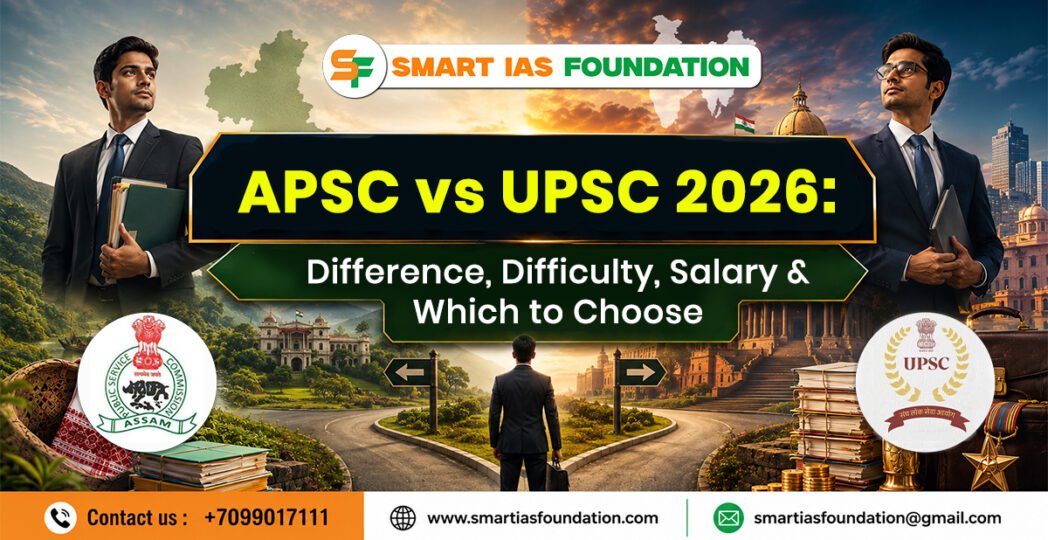
The question of APSC vs UPSC is one that every serious Assam civil services aspirant must answer — and answer correctly. Getting this decision wrong wastes years of preparation time. Choosing UPSC exclusively while ignoring APSC leaves candidates without a realistic near-term entry point into government service. Choosing APSC exclusively while abandoning UPSC closes the door to a national administrative career unnecessarily. The right answer — which this article explains in complete detail — is almost always both, simultaneously.
Understanding the APSC vs UPSC comparison requires looking at six dimensions: exam structure and pattern, syllabus coverage and overlap, competition and difficulty, salary and career growth, eligibility and attempt limits, and the strategic preparation approach that serves both. This article by Smart IAS Foundation covers every dimension of the APSC vs UPSC decision with the depth and specificity that Assam aspirants need.
Last Updated: May 3, 2026 | Relevant for APSC CCE 2025 (Prelims: July 5, 2026) and UPSC CSE 2026
📋 Table of Contents
- APSC vs UPSC – Quick Comparison Table
- Conducting Body & Service Scope
- Exam Pattern Comparison – Stage by Stage
- Prelims Comparison – GS Paper I & CSAT
- Mains Comparison – Papers, Marks & Optional
- Syllabus Overlap – What’s Common, What’s Different
- Difficulty Level & Competition Comparison
- Attempt Limit & Age Limit Comparison
- Salary & Career Growth Comparison
- ACS Officer vs IAS Officer – Real-world Difference
- Which Exam Should Assam Aspirants Target First?
- How to Prepare for APSC and UPSC Simultaneously
- Frequently Asked Questions
- Conclusion
1. APSC vs UPSC – Quick Comparison Table
| Parameter | APSC CCE | UPSC CSE |
|---|---|---|
| Full Name | Assam Public Service Commission Combined Competitive Examination | Union Public Service Commission Civil Services Examination |
| Conducting Body | Assam Public Service Commission (APSC) | Union Public Service Commission (UPSC) |
| Services Offered | Assam State Civil Services (ACS, APS, BDO, etc.) | IAS, IPS, IFS, IRS and 20+ Central Services |
| Jurisdiction | Assam only | All India + Central Government |
| Stages | 3 (Prelims → Mains → Interview) | 3 (Prelims → Mains → Personality Test) |
| Mains Papers | 6 papers (1,500 marks) | 9 papers (1,750 + 2 language papers) |
| Optional Paper | ❌ No Optional Paper | ✅ 2 Optional Papers (500 marks) |
| Language Papers | ❌ No Language Papers | ✅ 2 Language Papers (qualifying) |
| Assam-specific Paper | ✅ GS Paper V – Assam (300 marks) | ❌ No state-specific paper |
| Attempt Limit | No limit (only age limit) | General: 6 | OBC: 9 | SC/ST: unlimited |
| Age Limit (General) | 21–38 years (as on 01.01.2025) | 21–32 years |
| Vacancies (approx.) | 50–150 per cycle | ~900–1,000 per year |
| Applications per cycle | 2–3 lakh | 10–11 lakh |
| Entry Level Post | SDO / EAC (ACS); DSP (APS) | SDM / Joint Magistrate (IAS); DSP / ASP (IPS) |
| Highest Post | Chief Secretary of Assam | Cabinet Secretary of India |
| Syllabus Overlap | ~80% overlap in GS Papers I–IV | |
2. Conducting Body & Service Scope
The fundamental APSC vs UPSC distinction begins with who conducts the exam and what it leads to.
APSC CCE is conducted by the Assam Public Service Commission — a constitutional body (Article 315) established to ensure merit-based recruitment to Assam’s state civil services. It selects officers for state cadre services: primarily the Assam Civil Service (ACS), Assam Police Service (APS), and allied services like BDO, Inspector of Taxes, and Labour Officer. Officers selected through APSC CCE serve the people of Assam — in Assam’s districts, blocks, and state government departments — for their entire career unless specifically empanelled into the IAS.
UPSC CSE is conducted by the Union Public Service Commission — India’s central recruiting authority for the highest civil services. It recruits for three categories: All India Services (IAS, IPS, IFS), Group A Central Services (IRS, IPoS, IA&AS, etc.), and Group B Central Services. Officers selected through UPSC CSE are assigned to All India cadres — an IAS officer from Assam cadre serves in Assam but can also be posted to the Centre, to other states on deputation, and to international bodies. The scope is genuinely national.
📌 Key APSC vs UPSC Insight on Service Scope:
In the APSC vs UPSC comparison of service scope, neither is inherently “better” — they serve different ambitions. If your goal is to serve Assam’s communities at the district level, build deep administrative roots in your own state, and be the person people in your district turn to in times of crisis — ACS is the right answer. If your goal is a national administrative career with policy influence at the Central Government level, international postings, and a career that spans states and institutions — IAS is the answer. The good news is that 80% of the preparation path is identical.
3. Exam Pattern Comparison – Stage by Stage
| Stage | APSC CCE | UPSC CSE |
|---|---|---|
| Prelims Stage | 2 papers; GS Paper I (100 Q, 200 marks, merit); CSAT Paper II (80 Q, 200 marks, qualifying 33%); 2 hrs each | 2 papers; GS Paper I (100 Q, 200 marks, merit); CSAT Paper II (80 Q, 200 marks, qualifying 33%); 2 hrs each |
| Mains Stage | 6 descriptive papers; 1,500 marks total; No Optional; No Language papers; Includes dedicated Assam GS Paper V (300 marks) | 9 descriptive papers; GS I–IV (1,000 marks) + Essay (250) + 2 Optional (500) + 2 Language (qualifying); Total merit marks: 1,750 |
| Interview Stage | Viva-Voce; marks vary by post; added to Mains for final merit; 20–45 minutes | Personality Test; 275 marks; added to Mains for final merit; typically 25–45 minutes |
| Total Merit Marks | 1,500 (Mains) + Interview marks | 1,750 (Mains) + 275 (Interview) = 2,025 marks |
The Prelims stage is where the APSC vs UPSC pattern is most similar — both use the same GS Paper I + CSAT format with identical qualifying criteria for CSAT (33%). The divergence begins sharply at the Mains stage.
4. Prelims Comparison – GS Paper I & CSAT
4.1 GS Paper I – Where APSC and UPSC Diverge Most at Prelims
| Subject Area | APSC GS Paper I (Approx. Qs) | UPSC GS Paper I (Approx. Qs) |
|---|---|---|
| Assam GK (all aspects) | 25–30 (28% of paper) | 0–2 (negligible) |
| History (India) | 15–18 | 15–20 |
| Geography | 12–15 | 15–20 |
| Indian Polity | 10–12 | 12–18 |
| Economy | 10–12 | 12–15 |
| Environment & Ecology | 8–10 | 15–20 |
| General Science | 8–10 | 8–12 |
| Current Affairs | 8–10 | 15–25 |
The starkest APSC vs UPSC difference at Prelims is the Assam GK section. APSC dedicates 25–30 questions to Assam-specific knowledge — nearly 30% of the paper. UPSC has no equivalent. This means an Assam aspirant preparing primarily for UPSC, who has not built dedicated Assam GK preparation, will typically underperform in APSC Prelims despite being well-prepared in the common GS subjects.
4.2 CSAT Comparison
The CSAT Paper II is identical in structure in both APSC vs UPSC — same 80-question format, same 200-mark paper, same 33% qualifying threshold. The difficulty level and question types are also broadly similar. A candidate prepared for UPSC CSAT is fully prepared for APSC CSAT, and vice versa.
5. Mains Comparison – Papers, Marks & Optional
| Paper | APSC CCE | UPSC CSE |
|---|---|---|
| Essay | 200 marks | 250 marks |
| GS Paper I (History, Geography, Culture) | 300 marks | 250 marks |
| GS Paper II (Polity, Governance, IR) | 300 marks | 250 marks |
| GS Paper III (Economy, Environment, Technology) | 300 marks | 250 marks |
| GS Paper IV – Ethics | 300 marks | 250 marks |
| GS Paper V – Assam Paper | 300 marks ✅ | ❌ No equivalent |
| Optional Papers | ❌ None | ✅ 2 papers × 250 = 500 marks |
| Language Papers | ❌ None | ✅ 2 papers (qualifying) |
| Total Mains Merit Marks | 1,500 | 1,750 |
📌 Critical APSC vs UPSC Mains Difference – Optional Paper:
The Optional Paper is the single most structurally significant difference in the APSC vs UPSC Mains comparison. UPSC’s two Optional Papers contribute 500 marks to the final merit — and Optional subject performance is frequently cited as the biggest determinant of UPSC final rank (after GS). APSC has NO Optional Paper. This means that a candidate who has an exceptionally strong Optional subject (Literature, Mathematics, Political Science, etc.) gains a significant structural advantage in UPSC but derives no benefit from that specialisation in APSC. Conversely, a candidate who is a strong GS generalist but without a strong Optional background is better served by APSC first.
6. Syllabus Overlap – What’s Common, What’s Different
The APSC vs UPSC syllabus comparison reveals that the two exams share approximately 80% of their content across the GS papers. This is the strategic foundation for simultaneous preparation.
| Subject | In APSC Syllabus | In UPSC Syllabus | Note |
|---|---|---|---|
| Modern Indian History | ✅ | ✅ | APSC adds Assam-specific modern history |
| Ancient & Medieval India | ✅ | ✅ | Common content; UPSC goes deeper |
| World History | ✅ (Mains) | ✅ (Mains) | Similar coverage in Mains GS I |
| Indian Geography | ✅ | ✅ | APSC adds Assam geography; UPSC adds World Geography |
| Indian Polity & Constitution | ✅ | ✅ | APSC emphasises Sixth Schedule, BTC, NRC heavily |
| Indian Economy | ✅ | ✅ | APSC adds Assam state economy; UPSC goes deeper on monetary policy |
| Environment & Ecology | ✅ | ✅ | UPSC has higher weightage in Prelims; APSC adds NE ecology |
| Ethics, Integrity, Aptitude | ✅ (GS IV) | ✅ (GS IV) | Similar; APSC case studies use Assam admin contexts |
| Assam History, Culture, Geography, Economy | ✅ GS Paper V (300 marks) | ❌ Not tested | Unique to APSC; no preparation benefit for UPSC |
| Optional Subject | ❌ Not required | ✅ 500 marks — critical | No overlap; must be prepared separately for UPSC |
7. Difficulty Level & Competition Comparison
The APSC vs UPSC difficulty comparison requires separating two different dimensions: the depth of preparation required (content difficulty) and the level of competition (selection ratio).
7.1 Content Difficulty
- UPSC Prelims GS Paper I is more difficult than APSC Prelims GS Paper I in most subject areas — UPSC questions are more analytical, less factual, and demand a higher level of conceptual clarity. Exception: APSC’s Assam GK section (25–30 questions) has no UPSC equivalent and is uniquely challenging for candidates who have not built dedicated Assam-specific preparation.
- UPSC Mains requires significantly greater depth than APSC Mains — the Optional Papers alone require specialist-level mastery of a chosen subject; UPSC’s language papers require proficiency in the chosen Indian language and English; and UPSC’s GS Mains answers are expected to demonstrate greater analytical sophistication and policy awareness than APSC equivalent answers.
- APSC Mains is comparatively more accessible for a well-prepared general candidate — but the GS Paper V (Assam, 300 marks) creates a category of difficulty that UPSC-prepared candidates often underestimate.
7.2 Selection Ratio
| Metric | APSC CCE | UPSC CSE |
|---|---|---|
| Applications per cycle | ~2–3 lakh | ~10–11 lakh |
| Vacancies per cycle | 50–150 | ~900–1,000 |
| Selection ratio (approx.) | 0.05–0.07% | 0.09% |
| Prelims qualifiers sent to Mains (approx.) | 10–15× vacancies | 12–15× vacancies |
A critical observation in the APSC vs UPSC competition comparison: while UPSC has far more vacancies in absolute numbers, the selection ratio at APSC is actually comparable to or slightly harder than UPSC when calculated as selected/applied. This is because APSC’s applicant pool — while smaller — is drawn almost entirely from Assam graduates, creating a focused competition among people who know the state’s context deeply. Do not assume APSC is “easier” than UPSC in terms of competition.
8. Attempt Limit & Age Limit Comparison
| Category | APSC CCE – Age Limit | APSC – Attempt Limit | UPSC CSE – Age Limit | UPSC – Attempt Limit |
|---|---|---|---|---|
| General | 21–38 years | No limit | 21–32 years | 6 attempts |
| OBC/MOBC | 21–41 years | No limit | 21–35 years | 9 attempts |
| SC/ST | 21–43 years | No limit | 21–37 years | Unlimited |
| PwBD | +10 years over category | No limit | +10 years over category | +3 over category limit |
The attempt limit difference is one of the most strategically important factors in the APSC vs UPSC comparison for General category candidates. A General category aspirant has only 6 UPSC attempts — if they start at 21, their last attempt at 32 is when UPSC closes for them (age limit). However, they can continue appearing for APSC CCE until age 38 — giving them 6 more potential years after UPSC closes. This asymmetry means that for General category candidates, managing UPSC attempts carefully and not “wasting” them on underprepared attempts is critically important — while APSC gives more room.
9. Salary & Career Growth Comparison
| Career Stage | APSC ACS Officer | UPSC IAS Officer |
|---|---|---|
| Entry Post | SDO / EAC | SDM / Joint Magistrate (after 2-year probation) |
| Entry Basic Pay | ₹56,100/month | ₹56,100/month (Junior Time Scale) |
| Entry In-hand Salary | ~₹80,000–87,000/month | ~₹85,000–95,000/month (slightly higher due to some Central allowances) |
| DC Level (15–20 years) | ~₹1,20,000–1,50,000/month | ~₹1,40,000–1,70,000/month |
| Secretary Level (30+ years) | Secretary, Govt. of Assam: ₹1,44,200 basic | Secretary, Govt. of India: ₹2,25,000 basic |
| Highest Post | Chief Secretary, Assam | Cabinet Secretary, India (₹2,50,000 fixed) |
| Promotion Speed | DPC-based; depends on vacancies | Time-bound (guaranteed minimum promotion timeline) |
The salary verdict in the APSC vs UPSC comparison: identical at entry, moderately divergent at mid-career, significantly divergent at senior levels. An IAS officer who reaches Secretary/Joint Secretary at the Centre earns substantially more than an ACS officer at the same seniority — primarily because Central Government pay scales and deputation allowances are higher than state government equivalents for the same number of years of service.
10. ACS Officer vs IAS Officer – Real-world Difference
Beyond salaries and exam patterns, the APSC vs UPSC comparison ultimately comes down to what the job actually looks like on the ground. Here is the honest, ground-level comparison:
| Dimension | ACS Officer (APSC) | IAS Officer (UPSC) |
|---|---|---|
| Home State Posting | Always in Assam | Cadre-based; Assam cadre IAS serves in Assam + NE region + Centre |
| Community Connection | Deep – knows local community, language, culture | Variable – depends on cadre allocation |
| Authority at DC Level | Full DC/DM powers in Assam district | Full DC/DM powers (identical at district level) |
| Policy Influence | Assam state policy; advisory role to state government | State + national policy; Central Government ministry roles |
| Transfer Frequency | Regular; within Assam districts and departments | Regular; between districts, state government, and Centre |
| International Opportunities | Limited unless seconded to Central/international bodies | Available (UN, World Bank, bilateral postings) |
| Social Respect in Assam | Very high — DC is most recognised government figure locally | Very high — but fewer IAS serve in Assam at any given time |
11. Which Exam Should Assam Aspirants Target First?
The APSC vs UPSC “which first” question has no single right answer — it depends on your age, your background, your Optional subject strength, and your personal goal. Here is the framework Smart IAS Foundation uses to advise candidates:
Target APSC CCE First (or Simultaneously) If:
- You are above 28 years — you have fewer UPSC attempts remaining; APSC’s higher age limit (38 for General) gives you more opportunity
- You want to serve Assam specifically — your motivation is district-level impact in Assam’s communities, not a national administrative career
- You do not have a strong Optional subject — APSC’s no-Optional structure suits strong GS generalists better than UPSC
- You want to enter government service sooner — APSC CCE cycles are more frequent relative to UPSC; getting into service early while continuing UPSC preparation is a rational strategy
- You are a strong Assam GK candidate — your deep Assam knowledge is an asset in APSC that yields no equivalent return in UPSC
Target UPSC CSE First If:
- You are under 26 years — you have maximum UPSC attempts available; maximise the years when the opportunity is fullest
- You have a strong Optional subject — Literature, Mathematics, Political Science, PSIR, Sociology, or other high-scoring Optional subjects give you a structural advantage in UPSC that APSC cannot reward
- You are comfortable in English medium — UPSC answers are predominantly in English; if English is a weak point, APSC’s Assamese option is more accessible
- Your career goal is national-level policy influence — Secretary to Government of India, international posting, central ministry roles
📌 Smart IAS Foundation’s Recommended Answer to APSC vs UPSC Which First:
Prepare for both simultaneously from Day 1. The 80% syllabus overlap means you are not doubling your workload — you are adding approximately 20% extra for UPSC-specific content (Optional subject depth, language papers, additional GS depth) and 10–15% extra for APSC-specific content (Assam GK, GS Paper V). An aspirant who attempts only APSC and ignores UPSC wastes their GS preparation. An aspirant who attempts only UPSC and ignores APSC risks years without government service entry. The integrated approach serves both goals simultaneously and is the strategic foundation of our KARMYOGI Combined APSC+UPSC Course.
12. How to Prepare for APSC and UPSC Simultaneously
The APSC vs UPSC simultaneous preparation strategy is built on the 80% overlap principle. Here is how to structure it:
Phase 1 — Common Foundation (Months 1–4): 80% of preparation time
- Complete all NCERTs (Class 6–12) for History, Geography, Polity, Economy, Science — these serve both exams equally
- Standard reference books: Laxmikanth (Polity), Bipin Chandra (Modern History), Ramesh Singh (Economy), G.C. Leong (Geography), Shankar IAS (Environment) — all serve both exams
- Daily newspaper reading: The Hindu (national current affairs — UPSC and APSC) + The Assam Tribune (Assam current affairs — APSC specific)
Phase 2 — Divergence: APSC-specific (10–15% time) + UPSC-specific (10–15% time)
APSC-specific additions:
- Dedicated Assam GK notebook (from Month 1 — 30 minutes daily)
- GS Paper V preparation — Dr. Birinchi Kumar Barua (Assam History), Assam at a Glance, Assam Prohori magazine
- APSC PYQ papers (2018–2024) — topic-wise practice
- APSC Mains answer writing with Assam-specific dimensions from Month 4
UPSC-specific additions:
- Optional subject preparation — begin from Month 3; dedicate 2 hours daily
- Language paper preparation (if not English medium)
- Greater GS depth — UPSC demands more analytical rigour in Mains answers than APSC
- UPSC PYQ analysis (2014–2024) — understanding UPSC’s evolving question style
Phase 3 — Mock Tests and Revision (Month 8 onwards)
- Alternate APSC mock tests and UPSC mock tests weekly
- Separate answer writing tracks — APSC Assam angle vs UPSC national angle
- Full-length paper simulations for both exams under timed conditions
For the complete month-wise integrated study plan, read our APSC CCE 2026 Preparation Strategy guide which includes UPSC integration notes.
🎯 Prepare for APSC & UPSC Simultaneously – with Expert Guidance
Smart IAS Foundation’s KARMYOGI programme – integrated APSC + UPSC preparation, dedicated Assam GK, expert faculty. Guwahati & Jorhat since 2009.
13. Frequently Asked Questions – APSC vs UPSC
Which is more difficult – APSC CCE or UPSC CSE?
In the APSC vs UPSC difficulty comparison, UPSC CSE is generally more competitive nationally — approximately 10–11 lakh apply for ~1,000 vacancies vs 2–3 lakh apply for 50–150 APSC vacancies. However, the selection ratios are broadly comparable. Content-wise, UPSC demands greater depth — particularly the Optional Paper (500 marks) and deeper GS Mains analysis. APSC’s unique challenge is GS Paper V (Assam paper, 300 marks) which has no UPSC equivalent and requires dedicated Assam-specific preparation that most generic UPSC study materials do not cover.
Can I prepare for APSC and UPSC simultaneously?
Yes — and Smart IAS Foundation strongly recommends this for Assam aspirants. In the APSC vs UPSC syllabus comparison, approximately 80% of content is common across GS Papers I–IV. A structured integrated plan covers the common content for both, adds UPSC-specific Optional subject preparation, and adds APSC-specific Assam GK (GS Paper V) preparation. This is more efficient than sequential preparation. Our KARMYOGI programme at Smart IAS Foundation is designed specifically for this integrated APSC + UPSC preparation approach.
What is the main difference between APSC and UPSC?
The main APSC vs UPSC differences are: (1) Conducting body — APSC (Assam state) vs UPSC (Central Government); (2) Services — APSC leads to Assam State Civil Services; UPSC leads to All India Services (IAS, IPS, IFS) and Central Services; (3) Mains structure — APSC has 6 papers, no Optional, includes Assam paper (300 marks); UPSC has 9 papers including 2 Optional papers (500 marks) and 2 Language papers; (4) Attempt limit — APSC has no limit; UPSC limits General to 6 attempts; (5) Age limit — APSC General: 38 years; UPSC General: 32 years; (6) Geographic scope — APSC serves Assam; UPSC serves all of India and beyond.
Which exam should an Assam aspirant target first?
In the APSC vs UPSC “which first” decision, Smart IAS Foundation recommends preparing for both simultaneously due to the 80% syllabus overlap. If forced to choose: target APSC first if you are above 28 (fewer UPSC attempts available), want to serve Assam specifically, lack a strong Optional subject, or want government service entry sooner. Target UPSC first if you are under 26, have a strong Optional subject, seek a national administrative career, and have multiple attempts available.
Is ACS better than IAS?
In the APSC vs UPSC career comparison, ACS and IAS are not “better or worse” — they serve different ambitions. IAS has a higher career ceiling (Secretary to Government of India, Cabinet Secretary), national scope, faster promotions, and higher senior-level salary. ACS serves Assam specifically, offers deep community roots, provides full district-level authority (DC/DM powers identical to IAS at district level), and career security in Assam’s state government. For someone committed to serving Assam’s people at the district level, ACS provides everything IAS does locally.
What is the syllabus overlap between APSC and UPSC?
The APSC vs UPSC syllabus overlap is approximately 80% across GS Papers I–IV — History, Geography, Indian Polity, Economy, Environment, Ethics, and Current Affairs are common to both. Key differences: APSC has GS Paper V (Assam, 300 marks) with no UPSC equivalent; UPSC has Optional Papers (500 marks) not required in APSC; UPSC has Language Papers not required in APSC; and APSC Prelims has 25–30 Assam GK questions not tested in UPSC.
What is the difference in salary between APSC ACS and UPSC IAS?
In the APSC vs UPSC salary comparison, entry-level salaries are identical — both start at ₹56,100 basic pay with in-hand of approximately ₹80,000–90,000 per month. Salary diverges with seniority: senior IAS officers accessing Central Government Secretary-level posts earn ₹2,25,000 basic pay versus ₹1,44,200 for senior ACS at state Secretary level. The practical difference at DC level (15–20 years of service) is more modest — ₹1,20,000–1,50,000 in-hand for ACS vs ₹1,40,000–1,70,000 for IAS at comparable seniority.
14. Conclusion
The APSC vs UPSC debate is built on a false premise — that these are competing choices requiring a single answer. They are not. For Assam aspirants, the two exams are complementary paths with an 80% common preparation base. Treating them as competing choices — “APSC or UPSC?” — costs you years of opportunity that an integrated approach preserves.
The honest APSC vs UPSC summary: UPSC is harder overall, leads to a higher career ceiling, and gives you 6 attempts as a General category candidate. APSC is Assam-specific, requires dedicated Assam GK preparation that UPSC does not reward, has no Optional Paper burden, and gives you unlimited attempts within your age limit. Both are worth preparing for. Both are worth attempting. And the preparation for one materially advances your readiness for the other — because 80% of the journey is the same road.
📌 Your Next 3 Steps:
- Read the APSC CCE Syllabus 2026 — map the APSC vs UPSC syllabus differences precisely and identify the 80% common content to prioritise first
- Read Best Books for APSC CCE — the same books serve both APSC and UPSC preparation for 80% of the content
- Book a Free Strategy Session — get a personalised integrated APSC + UPSC preparation plan from our faculty based on your age, background, and timeline